Module 4
Updated 2021/04/26
The Book of R: chapter 4.3 (factors), 8 (files)
Module 3 review
- Variable types: list, array, data frame
- List
- x = listVariable = list(numericVector, stringVector, logicVector, 77)
- listVariable[1] #access first list element
- listVariable[[1]] #access content of first element
- Array
- arrayVariable = array(c(vector1,vector2),dim = c(3,3,2))
- arrayVariable[,,1] #get matrix 1
- Data frame
- patientRecords = data.frame(name, age, smoker)
- patientRecords[1,] #row 1
- patientRecords[,1] #column 1
- patientRecords[1,2] #element at row 1, column 2
- patientRecords$age
Exercise: Querying data frames (10 minutes)
Using the same variable you read “gene_condition_source_id.txt” into for the previous exercise, find how many unique diseases are linked to TP53?
Hint: you can access vector elements matching a specific criteria using:
vectorVariable$colName[vectorVariable$colName=="string"]
Hint: ?unique
Exercise solution (5 minutes)
db <- read.table("gene_condition_source_id.txt",
                 header=T,sep="\t",quote="",comment.char="",
                 colClasses="character")
sum(db$AssociatedGenes == "TP53")
## [1] 15table(db$AssociatedGenes == "TP53")##
## FALSE TRUE
## 11046 15table(db$SourceName)##
## GeneReviews Human Phenotype Ontology
## 616 40 623
## MONDO NCBI curation OMIM
## 4917 3815 128
## OMIM phenotypic series Orphanet
## 619 303db$DiseaseName[db$AssociatedGenes == "TP53"]## [1] "Basal cell carcinoma, susceptibility to, 7"
## [2] "Carcinoma of pancreas"
## [3] "Familial cancer of breast"
## [4] "Li-Fraumeni syndrome"
## [5] "Li-Fraumeni syndrome"
## [6] "Choroid plexus papilloma"
## [7] "Choroid plexus papilloma"
## [8] "Osteosarcoma"
## [9] "Bone marrow failure syndrome 5"
## [10] "Nasopharyngeal carcinoma"
## [11] "Li-Fraumeni syndrome 1"
## [12] "Hepatocellular carcinoma"
## [13] "Colorectal cancer"
## [14] "Adrenocortical carcinoma, hereditary"
## [15] "Glioma susceptibility 1"db$DiseaseName[which(db$AssociatedGenes == "TP53")]## [1] "Basal cell carcinoma, susceptibility to, 7"
## [2] "Carcinoma of pancreas"
## [3] "Familial cancer of breast"
## [4] "Li-Fraumeni syndrome"
## [5] "Li-Fraumeni syndrome"
## [6] "Choroid plexus papilloma"
## [7] "Choroid plexus papilloma"
## [8] "Osteosarcoma"
## [9] "Bone marrow failure syndrome 5"
## [10] "Nasopharyngeal carcinoma"
## [11] "Li-Fraumeni syndrome 1"
## [12] "Hepatocellular carcinoma"
## [13] "Colorectal cancer"
## [14] "Adrenocortical carcinoma, hereditary"
## [15] "Glioma susceptibility 1"unique(db$DiseaseName[db$AssociatedGenes == "TP53"])## [1] "Basal cell carcinoma, susceptibility to, 7"
## [2] "Carcinoma of pancreas"
## [3] "Familial cancer of breast"
## [4] "Li-Fraumeni syndrome"
## [5] "Choroid plexus papilloma"
## [6] "Osteosarcoma"
## [7] "Bone marrow failure syndrome 5"
## [8] "Nasopharyngeal carcinoma"
## [9] "Li-Fraumeni syndrome 1"
## [10] "Hepatocellular carcinoma"
## [11] "Colorectal cancer"
## [12] "Adrenocortical carcinoma, hereditary"
## [13] "Glioma susceptibility 1"these_have_tp53 <- db$AssociatedGenes == "TP53"
unique(db$DiseaseName[these_have_tp53])## [1] "Basal cell carcinoma, susceptibility to, 7"
## [2] "Carcinoma of pancreas"
## [3] "Familial cancer of breast"
## [4] "Li-Fraumeni syndrome"
## [5] "Choroid plexus papilloma"
## [6] "Osteosarcoma"
## [7] "Bone marrow failure syndrome 5"
## [8] "Nasopharyngeal carcinoma"
## [9] "Li-Fraumeni syndrome 1"
## [10] "Hepatocellular carcinoma"
## [11] "Colorectal cancer"
## [12] "Adrenocortical carcinoma, hereditary"
## [13] "Glioma susceptibility 1"wc -l gene_condition_source_id.txt
## 11062 gene_condition_source_id.txtReview: data types vs. data structures
- Key programming concept
- Primitive types
- numeric, logical, string
- Types
- vector, matrix, array, list, data frame
- Data structure
- A structure created using types
- e.g. vector, data frame, tree
| All same data type | Mixed data types | |
|---|---|---|
| 1d | Vector | List |
| 2d | Matrix | Data frame |
| nd | Array |
One more variable type: Factors
- Stores categorical variables
- A variable which can be one of a limited number of values
- Create a factor using the factor() function
x = c(1,2,3,3,2,1,2,3,1)
x
## [1] 1 2 3 3 2 1 2 3 1f = factor(x)
f## [1] 1 2 3 3 2 1 2 3 1
## Levels: 1 2 3#A factor has levels: these are the possible values
levels(f)## [1] "1" "2" "3"Factors and data frames
name = c("patient1", "patient2", "patient3")
age = c(46, 49, 50)
smoker = c(T, F, T)

#By default data.frame() creates factors for string variable columns
patientRecords = data.frame(name, age, smoker)
patientRecords
str(patientRecords) #Note: "Factor w/ 3 levels"## 'data.frame': 3 obs. of 3 variables:
## $ name : chr "patient1" "patient2" "patient3"
## $ age : num 46 49 50
## $ smoker: logi TRUE FALSE TRUE#Tell data.frame() not to create factors
patientRecords2 = data.frame(name, age, smoker, stringsAsFactors=F)
str(patientRecords2)## 'data.frame': 3 obs. of 3 variables:
## $ name : chr "patient1" "patient2" "patient3"
## $ age : num 46 49 50
## $ smoker: logi TRUE FALSE TRUEExercise: Working with Factors (10 minutes)
Convert the following protein sequence (just the amino acid sequence part) to a factor and use it to count how many amino acids of each type are in a protein
Hint: ?summary
sp|P04637|P53_HUMAN Cellular tumor antigen p53 OS=Homo sapiens MEEPQSDPSVEPPLSQETFSDLWKLLPENNVLSPLPSQAMDDLMLSPDDIEQWFTEDPGPDEAPRMPEAAPPVAPAPAAPTPAAPAPAPSWPLSSSVPSQKTYQGSYGFRLGFLHSGTAKSVTCTYSPALNKMFCQLAKTCPVQLWVDSTPPPGTRVRAMAIYKQSQHMTEVVRRCPHHERCSDSDGLAPPQHLIRVEGNLRVEYLDDRNTFRHSVVVPYEPPEVGSDCTTIHYNYMCNSSCMGGMNRRPILTIITLEDSSGNLLGRNSFEVRVCACPGRDRRTEEENLRKKGEPHHELPPGSTKRALPNNTSSSPQPKKKPLDGEYFTLQIRGRERFEMFRELNEALELKDAQAGKEPGGSRAHSSHLKSKKGQSTSRHKKLMFKTEGPDSD
Exercise solution (5 minutes)
prot_string <- "MEEPQSDPSVEPPLSQETFSDLWKLLPENNVLSPLPSQAMDDLMLSPDDIEQWFTEDPGPDEAPRMPEAAPPVAPAPAAPTPAAPAPAPSWPLSSSVPSQKTYQGSYGFRLGFLHSGTAKSVTCTYSPALNKMFCQLAKTCPVQLWVDSTPPPGTRVRAMAIYKQSQHMTEVVRRCPHHERCSDSDGLAPPQHLIRVEGNLRVEYLDDRNTFRHSVVVPYEPPEVGSDCTTIHYNYMCNSSCMGGMNRRPILTIITLEDSSGNLLGRNSFEVRVCACPGRDRRTEEENLRKKGEPHHELPPGSTKRALPNNTSSSPQPKKKPLDGEYFTLQIRGRERFEMFRELNEALELKDAQAGKEPGGSRAHSSHLKSKKGQSTSRHKKLMFKTEGPDSD"
nchar(prot_string)
## [1] 393# prot_string <- sub("\\n","",prot_string)
prot <- strsplit(prot_string,split="")
length(prot)## [1] 1str(prot)## List of 1
## $ : chr [1:393] "M" "E" "E" "P" ...prot <- prot[[1]]
str(prot)## chr [1:393] "M" "E" "E" "P" "Q" "S" "D" "P" "S" "V" "E" "P" "P" "L" "S" ...testing <- strsplit(c("this","class","rocks"),"")
str(testing)## List of 3
## $ : chr [1:4] "t" "h" "i" "s"
## $ : chr [1:5] "c" "l" "a" "s" ...
## $ : chr [1:5] "r" "o" "c" "k" ...table(prot)## prot
##  A  C  D  E  F  G  H  I  K  L  M  N  P  Q  R  S  T  V  W  Y
## 24 10 20 30 11 23 12 8 20 32 12 14 45 15 26 38 22 18 4 9summary(prot)## Length Class Mode
## 393 character characterprot <- as.factor(prot)
str(prot)## Factor w/ 20 levels "A","C","D","E",..: 11 4 4 13 14 16 3 13 16 18 ...table(prot)## prot
## A C D E F G H I K L M N P Q R S T V W Y
## 24 10 20 30 11 23 12 8 20 32 12 14 45 15 26 38 22 18 4 9summary(prot)## A C D E F G H I K L M N P Q R S T V W Y
## 24 10 20 30 11 23 12 8 20 32 12 14 45 15 26 38 22 18 4 9Files
Key Programming Concept
Reminder: Redirect output and input
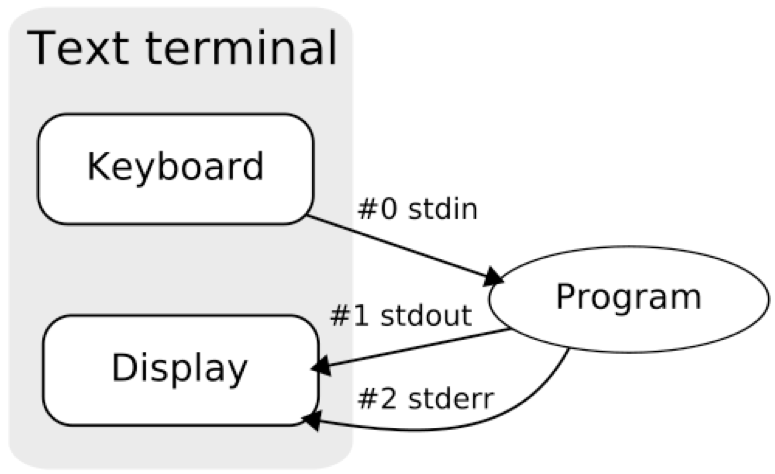
Redirect output to a file
$ grep cancer genes2phenotype.txt > myfile.txt
Will print all lines in “genes2phenotype.txt” that contain “cancer” to the file “myfile.txt” (no output to screen). Use “cat” or “more” to view the contents of myfile.txt
What is a file
A file is a set of data stored somewhere and given a name Every file is a series of binary numbers, usually thought of as a series of bytes *A bit is the smallest unit of data a computer can store: either 0 or 1 (a switch is off or on)
| Binary (base 2) | Number (base 10) |
|---|---|
| 00 | 0 |
| 01 | 1 |
| 10 | 2 |
| 11 | 3 |
A byte is 8 bits and can represent up to 2^8 = 256 values As a more compact representation, computers often display binary values in hexadecimal (base 16). Two hexademical digits = 16^2 = 256 values = 8 binary digits
| Hexademical (base 16) | Number (base 10) |
|---|---|
| 0 | 0 |
| 1 | 1 |
| 2 | 2 |
| … | … |
| a | 10 |
| … | … |
| f | 15 |
So a file can be thought of as a series of pairs of hexadecimal digits UNIX commands are available to view a file as this raw data e.g.
xxd fileOutput.png | head## 00000000: 8950 4e47 0d0a 1a0a 0000 000d 4948 4452 .PNG........IHDR
## 00000010: 0000 0307 0000 01da 0806 0000 0055 6735 .............Ug5
## 00000020: 9700 0000 0173 5247 4200 aece 1ce9 0000 .....sRGB.......
## 00000030: 0009 7048 5973 0000 1712 0000 1712 0167 ..pHYs.........g
## 00000040: 9fd2 5200 0040 0049 4441 5478 01ec dd07 ..R..@.IDATx....
## 00000050: b874 5579 f6f1 ad22 a002 4aef f0d2 11e9 .tUy..."..J.....
## 00000060: bd57 c150 c4cf 8a8a 251a a351 5193 8f8b .W.P....%..QQ...
## 00000070: 688c 628d 5882 31d1 98cf 2488 05a2 4004 h.b.X.1...$...@.
## 00000080: 312a 5de9 1d01 69d2 5fa4 f75e 6ddf fb5b 1*]...i._..^m..[
## 00000090: ba4e e61d e69c 33a7 cf99 b9d7 75ed b3e7 .N....3.....u...This is how a PNG image file is stored on disk (the first 80 bytes): #
{bash} 00000000: 8950 4e47 0d0a 1a0a 0000 000d 4948 4452 .PNG........IHDR 00000010: 0000 0307 0000 01da 0806 0000 0055 6735 .............Ug5 00000020: 9700 0000 0173 5247 4200 aece 1ce9 0000 .....sRGB....... 00000030: 0009 7048 5973 0000 1712 0000 1712 0167 ..pHYs.........g 00000040: 9fd2 5200 0040 0049 4441 5478 01ec dd07 ..R..@.IDATx.... #The data in a file can be represented in different ways
A common way for text to be represented is in ASCII format
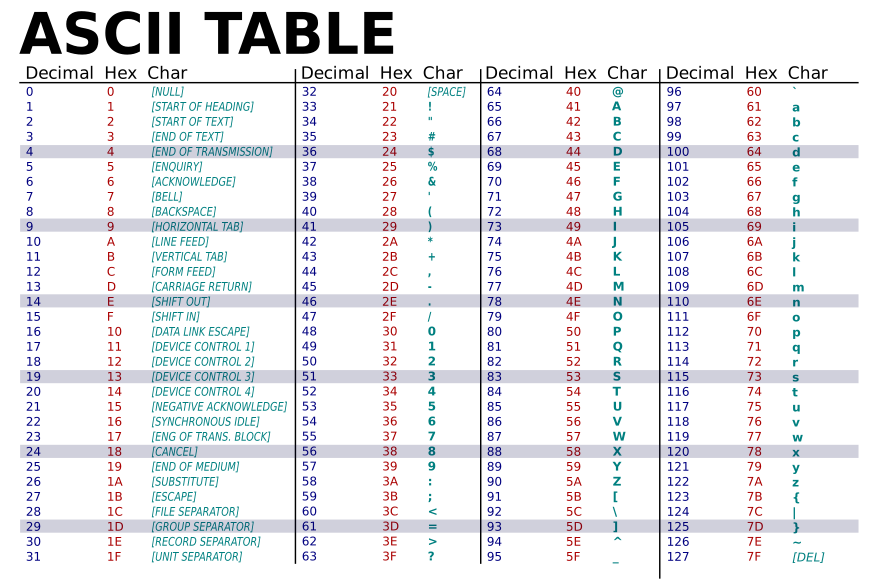
ASCII table from https://simple.wikipedia.org/wiki/ASCII
Numbers 32 to 126 define printable characters e.g. decimal 32 = space
Note that there are two different ways to say “next line”
- number 10 (hex: 0A) = line feed
- number 13 (hex: 0D) = carriage return
Different operating systems unfortunately use different ways (encodings) to represent “next line”.
macOS and UNIX use line feed (hex: 0A). Windows uses a combination of carriage return and line feed (hex: 0D 0A).
See more details at https://en.wikipedia.org/wiki/Newline
Exercise on your own: Use the UNIX xxd command to view a text file and see how the text (and a line break) is represented as ASCII codes.
Why did we learn this? There are different types of hidden or unexpected characters possible in a file and you sometimes need to be aware of them when reading and writing files. If in doubt, examine your file in a text editor, or use
headon the command line to view a file and make sure it is the format you are expecting.Tip: on UNIX, you can use the file command to see what type of format a file is.
file mydata.txt
file fileOutput.png
## mydata.txt: ASCII text, with CRLF line terminators
## fileOutput.png: PNG image data, 775 x 474, 8-bit/color RGBA, non-interlaced- A common type of file in data science is a table (like a spreadsheet worksheet, or data frame), usually represented as a tab-delimited format. This type of file should be explored in a spreadsheet application before you try to read it in R
Working with files in R
#Remember to set the working directory
getwd()
## [1] "D:/Dropbox/TA_MMG1002H_2020/p4b"#setwd("path")
#setwd("C:/MyDoc")
list.files()## [1] "_site.yml" "aaoutput.txt"
## [3] "ASCII-Table-wide.svg" "assignment2_sequence.txt"
## [5] "column.txt" "docs"
## [7] "fileOutput.png" "gene_condition_source_id.txt"
## [9] "GSE13924_RAW.tar" "GSM350771.CEL.gz"
## [11] "GSM350772.CEL.gz" "index.html"
## [13] "index.md" "mod_me.html"
## [15] "mod_me.Rmd" "mod_me_files"
## [17] "mod1.html" "mod1.Rmd"
## [19] "mod2.html" "mod2.Rmd"
## [21] "mod2.utf8.md" "mod2_files"
## [23] "mod3.html" "mod3.Rmd"
## [25] "mod4.Rmd" "mod5.Rmd"
## [27] "mod5exercise.fa" "mod6.Rmd"
## [29] "mod7.knit.md" "mod7.Rmd"
## [31] "mod8.Rmd" "mod9.Rmd"
## [33] "mod9.utf8.md" "mydata.txt"
## [35] "p4b.Rproj" "README.md"
## [37] "recipebookTOC.png" "row.txt"
## [39] "RStudioOptions.png" "site_libs"
## [41] "sum.R" "test.txt"
## [43] "thisisapdf.pdf" "thisisnotapdf.png"
## [45] "yeast_properties.txt"dir() #this does the same thing## [1] "_site.yml" "aaoutput.txt"
## [3] "ASCII-Table-wide.svg" "assignment2_sequence.txt"
## [5] "column.txt" "docs"
## [7] "fileOutput.png" "gene_condition_source_id.txt"
## [9] "GSE13924_RAW.tar" "GSM350771.CEL.gz"
## [11] "GSM350772.CEL.gz" "index.html"
## [13] "index.md" "mod_me.html"
## [15] "mod_me.Rmd" "mod_me_files"
## [17] "mod1.html" "mod1.Rmd"
## [19] "mod2.html" "mod2.Rmd"
## [21] "mod2.utf8.md" "mod2_files"
## [23] "mod3.html" "mod3.Rmd"
## [25] "mod4.Rmd" "mod5.Rmd"
## [27] "mod5exercise.fa" "mod6.Rmd"
## [29] "mod7.knit.md" "mod7.Rmd"
## [31] "mod8.Rmd" "mod9.Rmd"
## [33] "mod9.utf8.md" "mydata.txt"
## [35] "p4b.Rproj" "README.md"
## [37] "recipebookTOC.png" "row.txt"
## [39] "RStudioOptions.png" "site_libs"
## [41] "sum.R" "test.txt"
## [43] "thisisapdf.pdf" "thisisnotapdf.png"
## [45] "yeast_properties.txt"#file.create(), file.rename() and many moreData import and export
- We usually work with files using read and write functions
write.table(patientRecords, "mydata.txt", sep="\t")

mydata = read.table("mydata.txt")
mydata
Exercise: Practice reading and writing files (10 minutes)
Read the “gene_condition_source_id.txt” file dataFrame = read.table(“gene_condition_source_id.txt”, header=TRUE, sep=“, fill=TRUE, comment.char =”“, quote =”")
count the number of columns and rows
write one column to a file “column.txt” and write one row to a file “row.txt”
examine original and resulting files in a spreadsheet - did you get the correct answer?
Exercise solution (5 minutes)
db <- read.table("gene_condition_source_id.txt",
                 header=T,sep="\t",quote="",comment.char="",
                 colClasses="character")
nrow(db)
## [1] 11061ncol(db)## [1] 9identical(db[,"AssociatedGenes"],db$AssociatedGenes)## [1] TRUEwrite.table(db[,2],file="column.txt",quote=F,row.names=F,col.names=F)
write.table(db[1,],file="row.txt",sep="\t",
quote=F,row.names=F,col.names=F)head column.txt
wc -l column.txt## A2M
## A2M
## A2ML1
## A4GALT
## AAAS
## AAGAB
## AARS1
## AARS1
## AARS2
## AARS2
## 11061 column.txtless row.txt
awk -F '\t' 'END {print NF}' gene_condition_source_id.txt
awk -F '\t' '{print NF}' row.txt## 2 A2M C0002395 Alzheimer disease MONDO MONDO:0004975 104300 Feb 19 2020
## 9
## 9Conditional statements
Key Programming Concept
Conditional statements
- if condition is true, then run these commands
- The “if statement”
if (test_expression) {


  statement
}

#Note: indenting is optional, but is good style because indented code is easier to read- Example
x = 5
if (x > 0) {
  print("Positive number")
}
## [1] "Positive number"x = -5
if (x > 0) {
print("Positive number")
}if..else statement
if (test_expression) {
  statement1
} else {
  statement2
}- Example
x = 5
if (x > 0) {
  print("Positive number")
} else {
  print("Negative number")
}
## [1] "Positive number"if..else if statement
if (test_expression1) {
    statement1
} else if (test_expression2) {
    statement2
} else {
    statement3
}- Example
x = 5
if (x > 0) {
  print("Positive number")
} else if (x==0) {
  print("Zero")
} else {
  print("Negative number")
}
## [1] "Positive number"x = 0
if (x > 0) {
print("Positive number")
} else if (x==0) {
print("Zero")
} else {
print("Negative number")
}## [1] "Zero"x = -4
if (x > 0) {
print("Positive number")
} else if (x==0) {
print("Zero")
} else {
print("Negative number")
}## [1] "Negative number"Comparison operators
<           less than
<=          less than or equal to
>           greater than
>=          greater than or equal to
==          exactly equal to
!=          not equal to
!x          not x
x | y       x OR y
x & y       x AND y e.g. if((x != 3) & (x > 0))
Note: identical() function is more generic than == and it can work on any R object